

LIKE THE DARKNESS DOUBLED
The Bowery, 1977. A bar rank with heat and smoke, a band chasing dissonance into song, a bartender working to keep himself apart. The night swells with menace and anticipation, every note sharpening

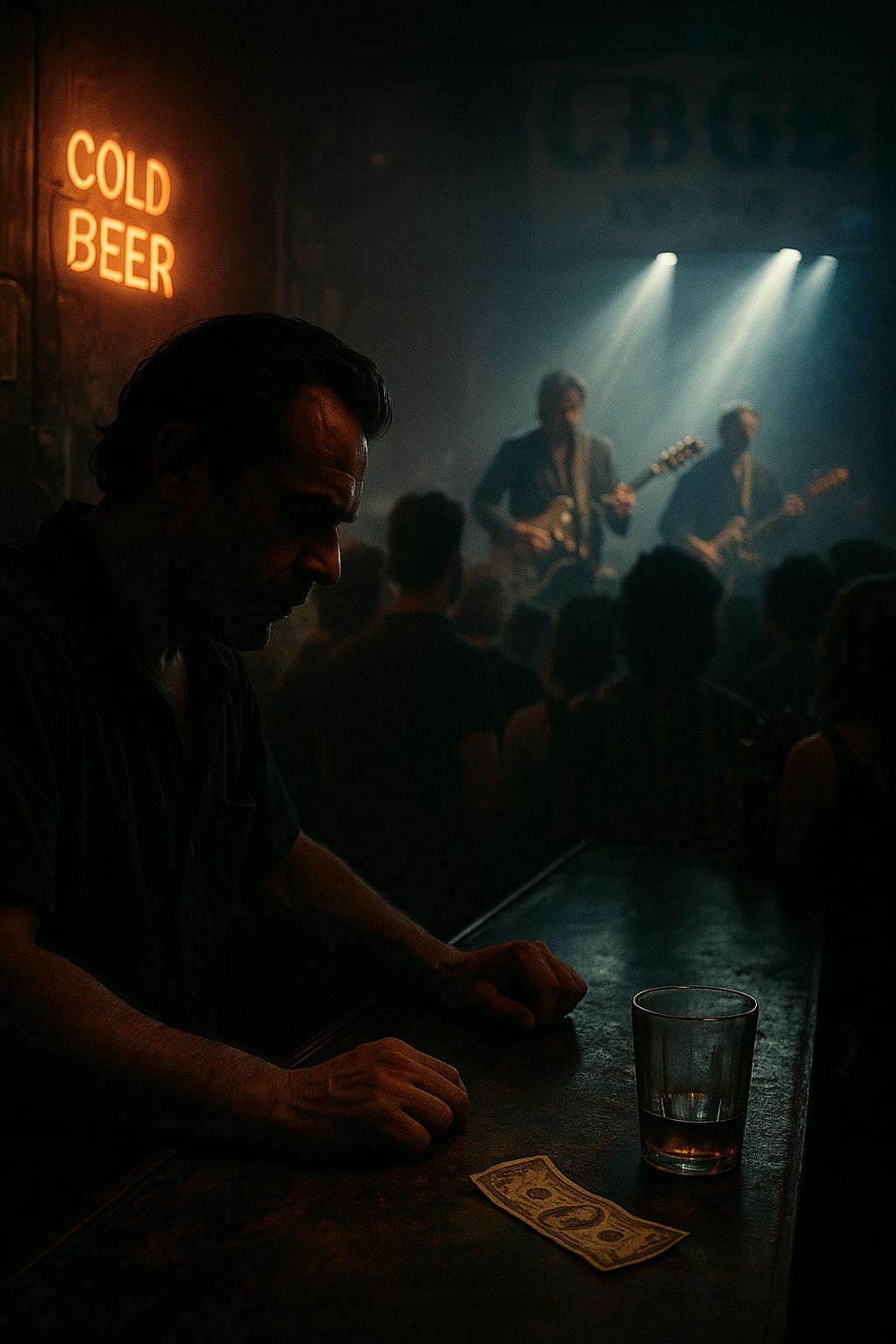
He came on at six, the Bowery already slick with the stink of summer steam and garbage, but inside CBGB the air was worse—old beer, piss, the faint ammonia of the men’s room, smoke layered thick enough to taste. He’d hit a small shot of horse in his walk-up, not enough to cloud the hands, just enough to make the neon glow holy and the bottles of Budweiser sweat in their bins like offerings.
The band fussed with their tuning. The pluck of two open strings rang against each other, a slow hum rolling thinner as the peg turned, until the waves collapsed into confluence. “Check, check,” someone spat into the mic. Two sharp snaps on the snare, sticks clouded overhead, and then it came—Verlaine’s Jazzmaster slashing a syncopated B minor, resolving jagged into D. A siren cutting the haze. Another guitar echoed its frenzied chromatic lick. Bass and drums hunted for footing, each instrument working in its own orbit until Verlaine’s voice drew them into shape:
I remember, like the darkness doubled.
This was Radiohead if Radiohead existed in the summer of Sam—precision and uncertainty colliding, every sound both on the edge of collapse and perfectly in place.
Behind the bar, the register drawer stuck on the third pull. He slammed it open, poured three Seagram’s 7s heavy on ice into plastic cups, and slid them to a pair of Rutgers kids whose skinny ties were already damp with sweat. Someone tipped with a $2 bill, folded once and left face up, Jefferson hovering pale green against the beer ring.
He kept pouring. The night stretched, elastic, toward a shimmer that might end at two a.m. or not at all. The horse kept him level, detached. That was the job: pour, count, and stay clear of other people’s collisions. Still, he caught the flicker—the older man leaning closer to the boy at the end of the bar, the way one body turned with eagerness while the other held back just slightly too long.
The bartender’s hands moved without pause, stacking cups, wiping a ring of whiskey from the counter. It wasn’t his place to care. But the question lodged anyway, stubborn as the drawer:
When something was about to happen, how far could a man stay out of it?
Amazing job transporting the reader to another era. Superb example of making time and place characters in a story.
Marquee Moon. A most underrated gem!